
Walk in calm.
Sit it at the real standard.
Realistic timed papers and writing marked by real tutors, not an algorithm. Built for NSW Year 4–6, and free for your first month.
No account needed for the diagnostic · See plans and pricing
A rectangular garden is 12 m by 8 m. A path 1 m wide runs around the outside. What is the area of the path?
Answer a real question, right here.
Pick an answer to see it marked instantly. No signup needed.
What number comes next in this pattern?
How marking works in the real product
- ✓ Instant ✓ / ✗ marking the moment you answer
- ✓ A clear, step-by-step worked solution
- ✓ Updates topic mastery, and weak spots get queued for tomorrow
Want the whole picture? Sit the free 28-minute diagnostic
Writing and reading classes, taught by a person.
Small group classes for the two Selective papers a child cannot really practise alone: Writing for Years 4 to 6, online or face to face, and Reading Comprehension for Years 5 and 6 on Sundays. Every piece is marked by hand, and the question bank comes with the class.
Book on the timetable and pay one invoice within 14 days. In January, a five-morning Holiday Course: a new kind of writing each day, finished under exam conditions and marked.
See the timetableFrom first paper to exam-ready
Sit a real, timed paper
No abstract quizzes. Your child sits a full paper under real conditions from day one. There are four baselines, one per subject and a little over two hours together, and they are what the plan and the coach read from.
Get a daily plan
Two or three ranked actions each day, weakest topic first, a writing piece if it’s been a while. They open the app and simply start the next best thing.
Watch the climb
Score trend, topic mastery and subject analytics, marked honestly. Progress shows up in numbers, not vibes, and it’s visible to parents.
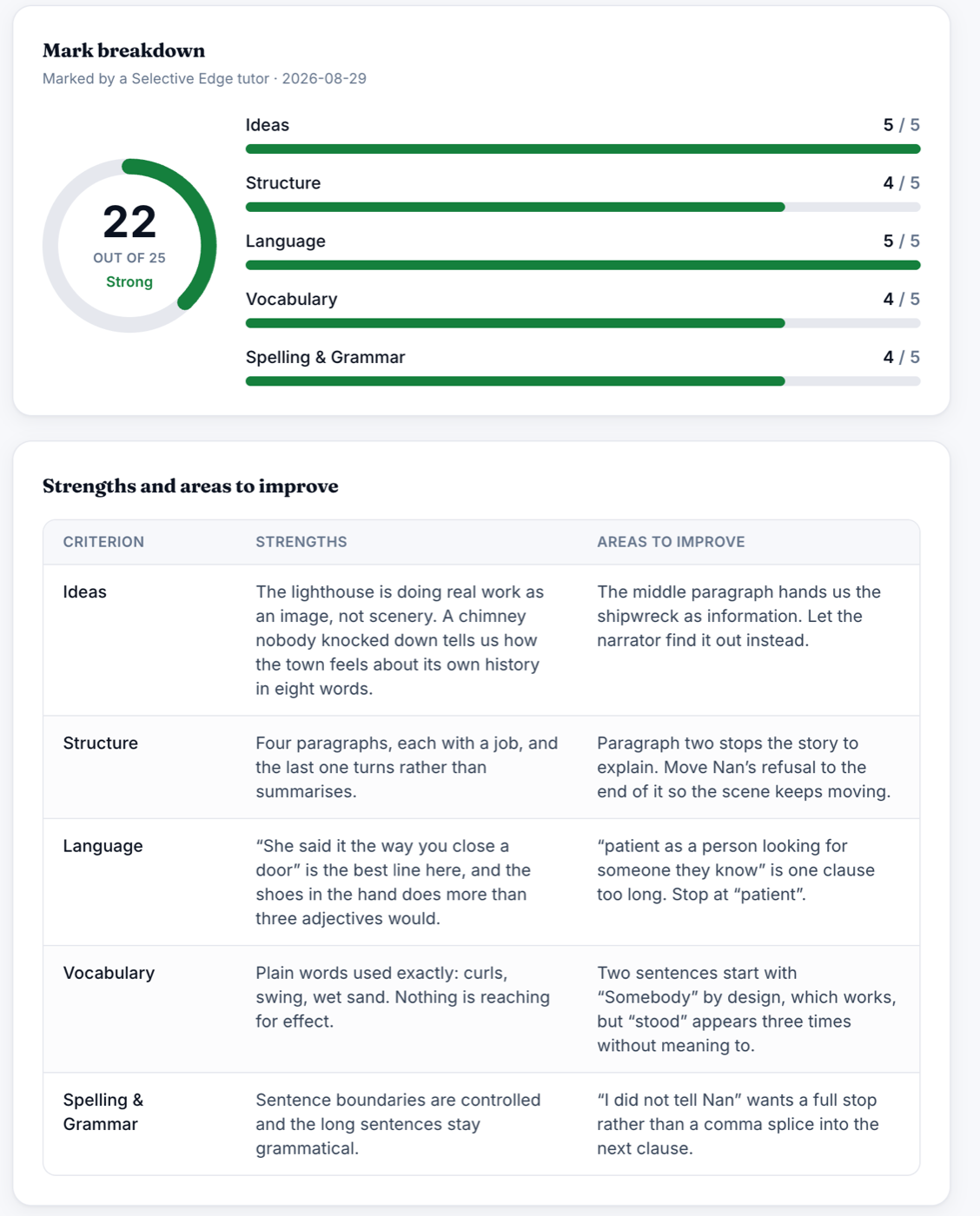
Marked by a human. Never an algorithm.
Every submitted piece is read by a real tutor and returned with a five-criterion rubric: a mark out of 25, what worked, and one specific thing to change, for each criterion separately.
This is the part a free question bank cannot copy, and it is the reason most families upgrade. Parents see the average tutor turnaround on the dashboard, so the timeline is visible rather than promised.
How marking works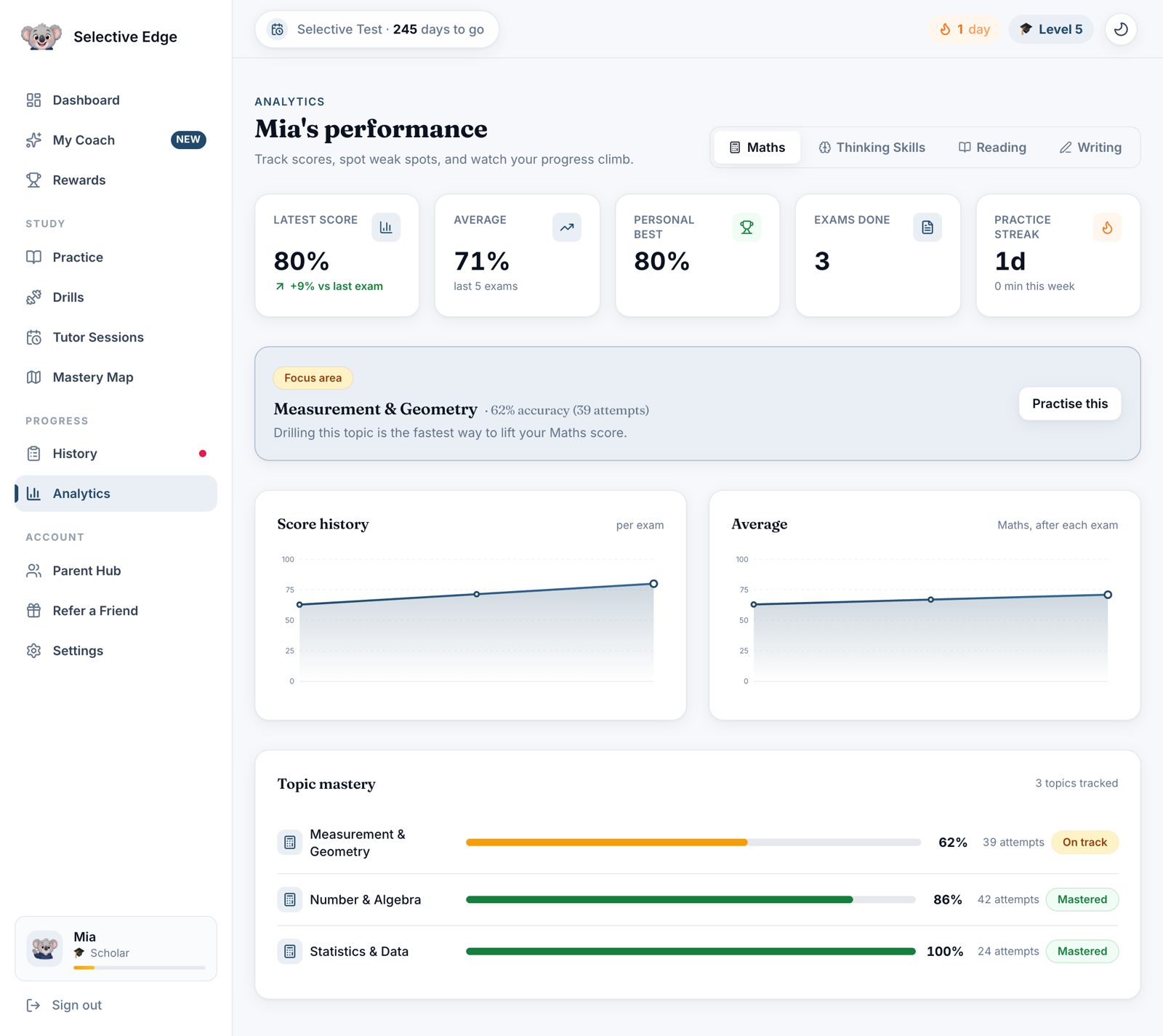
Progress you can actually see
Every subject is tracked on its own. Maths, Thinking Skills, Reading and Writing each get their own scores, their own trend and their own weakest topic, because a single blended number tells a parent nothing they can act on.
The numbers are honest. Cohort comparison only appears once the cohort is large enough, and the caveats say so.
See the parent dashboard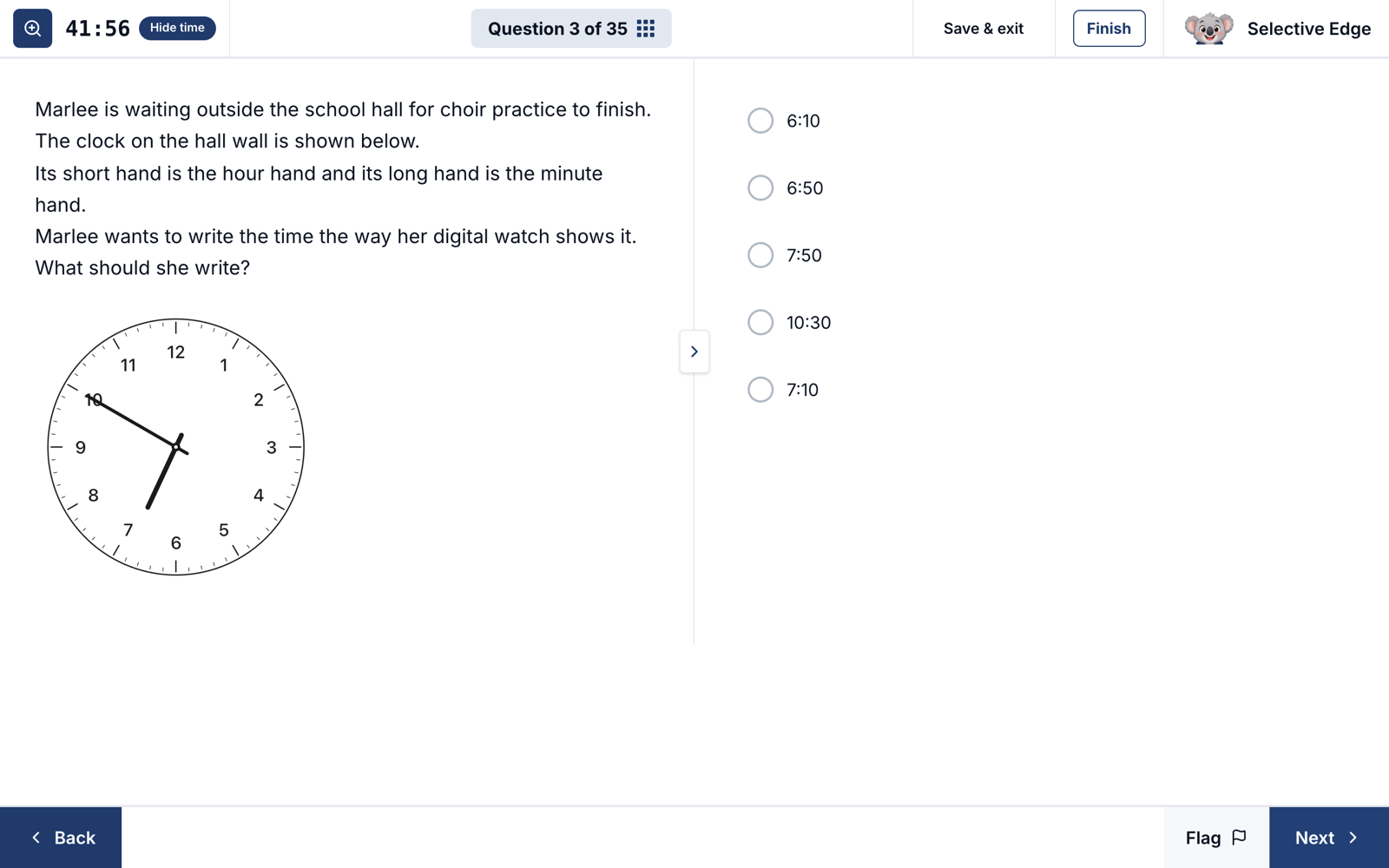
The real format, from the first paper
Five options, a visible clock, flag-for-review and a progress grid, in the layout the Selective Test actually uses. Pace is half of what the real paper measures, so practice that hides the clock is practising the wrong thing.
Diagrams are drawn to the exam's own register: a black hairline on white, no decoration, exactly what a child will meet on the day.
Explore the papers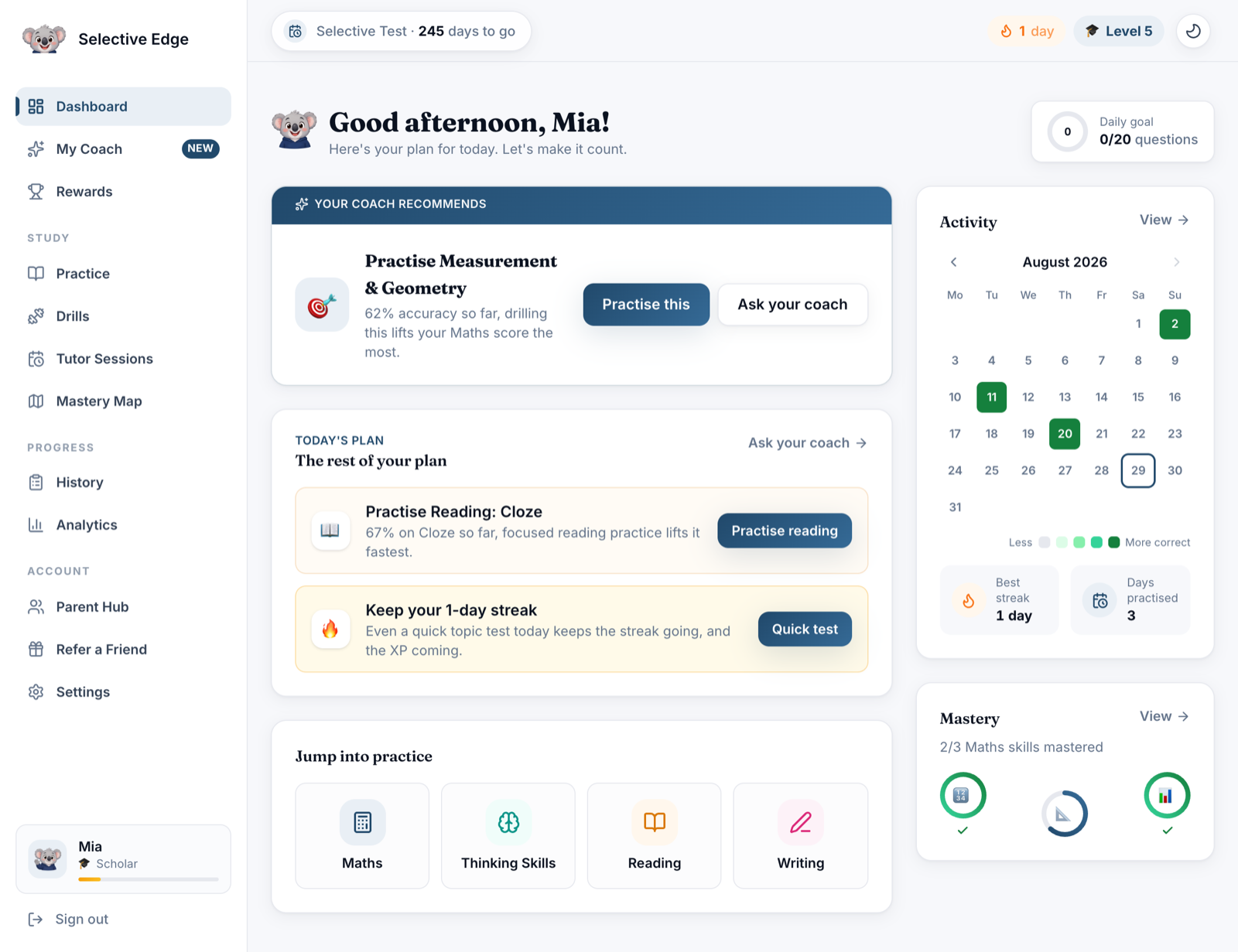
Stop guessing what to practise next
Selective Edge looks at recent performance and gives your child two or three ranked actions for the day, weakest topic first, with the reason printed next to each one.
They open the app, they know what to do, and they stop staring at a wall of options.
Explore the daily planBuilt to the real exam standard
Mathematics
Mathematical Reasoning2,830 questions- Number & Algebra
- Measurement & Geometry
- Statistics & Data
Writing
Written Expression2,031 prompts- Narrative
- Persuasive
- Diary entry
- News report
Reading
Reading Comprehension3,800 questions · 500 passages- Comparison
- Poetry
- Cloze
- Gapped text
- Multiple matching
Thinking Skills
Critical & Problem Solving784 questions- Logical analysis
- Finding procedures
- Evaluating evidence
- Evaluating reasoning
- Identifying mistakes
Real classes, marked by hand, counted.
Our own Selective writing course began on 11 October. Every piece a child writes is marked by a tutor, and each week's new piece comes back as a rewrite the week after. These are its numbers from the marking records, not estimates.
A rewrite is the same prompt written again after it was marked, which is the fair comparison: a different prompt measures the prompt as much as the child. Across those 14 rewrites the mark moved by +2.0 out of 25 on average. Small numbers, early in the term, and we will keep publishing them.
Marked by a person
Every piece is read by a tutor and marked on the Selective scheme: five criteria, a mark out of 25, each comment pointing at a line. No AI marking on writing, ever.
Back within 48 hours
Our median is 15 hours. Parents see the turnaround on their own dashboard, so it is a record rather than a promise.
The founder reads every email
A small operation by design. Questions, frustrations and requests all reach a person, and every reply is read.
Before you sign your child up
What does it cost?
Every paid plan starts with a free month, and nothing is charged until it ends. Standard is $23.99 a month on the annual plan, which works out under $6 a week and less than one Sydney tutoring session. There is also a free plan with one timed paper a week per subject if you would rather start slowly.
What year level is this for?
Year 4–6 in NSW. Year 5 is the prime year. The Selective Test is sat in May of Year 6. Year 4 students get a head start on format and pacing; Year 6 students still gain composure on writing and timed papers.
Is the writing feedback really from a human?
Yes. A real tutor reads every submitted piece and returns a five-criterion rubric score with specific strengths and improvements for each one. No AI on writing, ever.
How is this different from a tutoring centre?
Tutoring centres run weekly group classes on a fixed curriculum, mostly through worksheets. Selective Edge is built around realistic timed papers from day one, an adaptive daily plan, and tutor-marked writing, for less than the cost of one session a month.
How long until we see progress?
Most students see meaningful score movement within 6–8 weeks of regular practice. The dashboard shows the trend line per exam plus a rolling average, so progress is visible early and honestly.
Can I cancel anytime?
Yes. Paid plans are month to month with no lock-in. You can downgrade or cancel from your account at any time.
Start the free month.
Decide after you have seen it.
Unlimited practice and writing marked by real tutors, free for 30 days. Nothing is charged until the month ends, and you can cancel before then. Prefer to go slowly? The free plan gives you one timed paper a week per subject, no card.